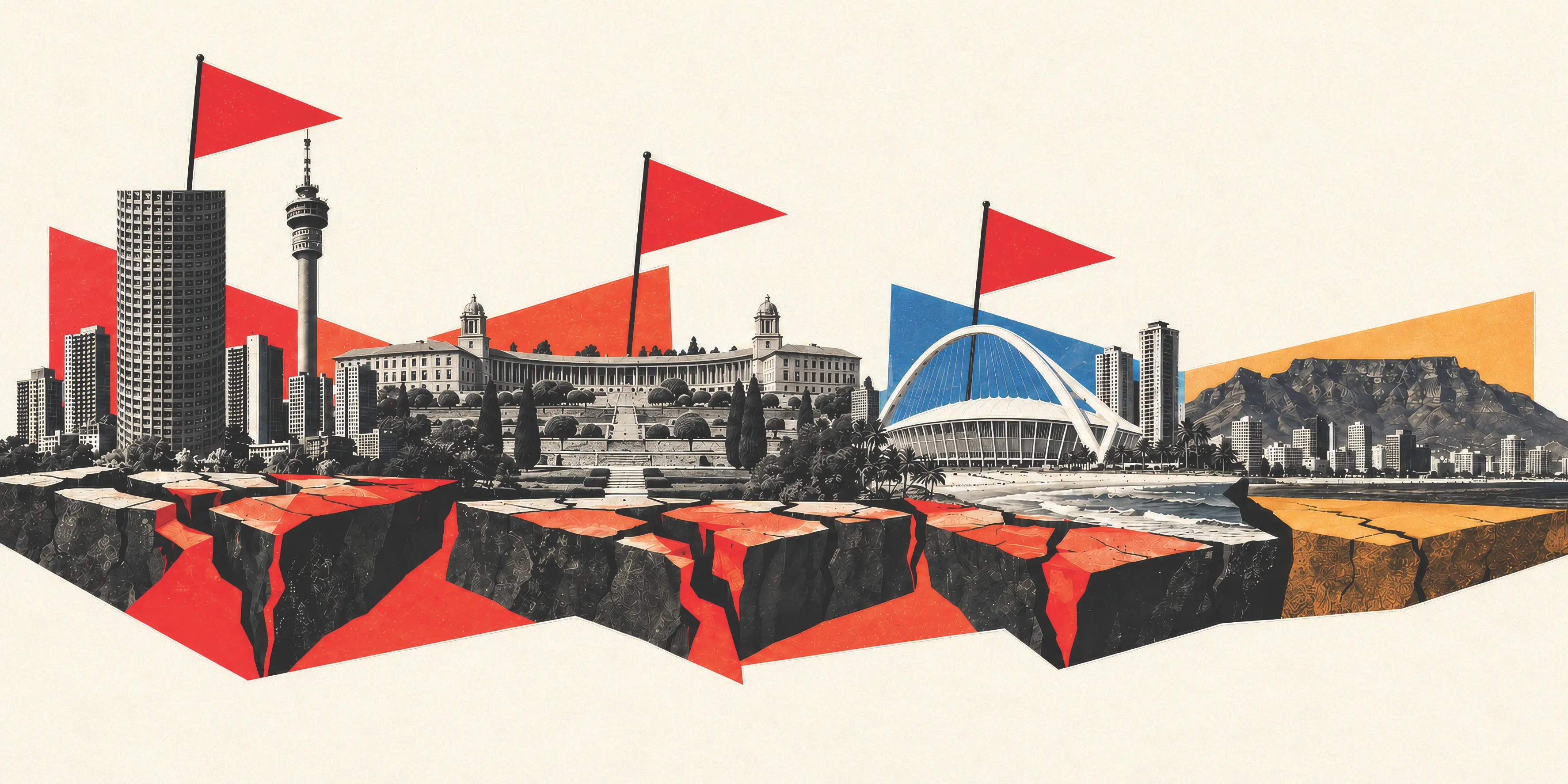
On Wednesday, the ANC faces a hole far bigger than the potholes Helen Zille, the DA’s Johannesburg mayoral candidate, has been swimming in. The ground beneath its urban power is giving way. The damage could reach beyond the councils it loses to the branches that will elect its next president.
Nowhere is that danger greater than in KwaZulu-Natal, where Cyril Ramaphosa’s ANC risks losing both its metropolitan foothold and the provincial machine that once helped determine who led the party.
Ramaphosa’s Zulu problem
At Nasrec in December 2017, KwaZulu-Natal — then the ANC’s biggest delegate bloc — largely backed Nkosazana Dlamini-Zuma. Ramaphosa won narrowly, helped over the line by Gauteng and David Mabuza’s Mpumalanga. He inherited a party whose most powerful province had backed his opponent.
He has never repaired that relationship, and its deterioration has compounded a deeper problem: the ANC’s Zanufication.
In Zimbabwe, Zanu-PF’s loss of urban support from 2000 onwards left it increasingly dependent on the countryside. The ANC has been drifting in the same direction. But retreating into rural strongholds means retreating from where most South Africans live.
The warning came in 2016. The ANC lost control of Johannesburg, Tshwane and Nelson Mandela Bay, and fell below 50% in Ekurhuleni. This happened on Jacob Zuma’s watch.
Yet eThekwini appeared to offer protection. The ANC held about 56% there in 2016, helped by Zuma’s provincial appeal. Under Ramaphosa, it fell to about 42% in 2021. In the 2024 provincial election, Zuma’s uMkhonto weSizwe (MK) party took roughly 45% across KwaZulu-Natal, pushing the ANC into third place with about 17%.
These are different elections, but the direction is unmistakable. Polling ahead of Wednesday points to MK emerging as the largest party in eThekwini.
The ANC’s own diagnosis is bleak. Its report to last December’s national general council traced its decline through the loss of major metros. Rural structures predominated among branches responding to its survey. Chief whip Mdumiseni Ntuli warned against becoming a purely rural party.
At the same gathering, Fikile Mbalula compared the provincial rescue team to a Toyota Tazz when the party had expected a Ferrari. Leaders were fighting over who should lead rather than rebuilding.
Part of this is Zuma’s doing. Under him, the ANC expanded deep into the IFP’s base, mistaking some voters’ personal allegiance to Zuma for permanent loyalty. In 2024, Zuma exposed the difference by campaigning for MK and helping it displace the ANC as the province’s largest party.
In Durban, unreliable water, sewage failures and deteriorating infrastructure supplied further reasons to leave. A party asking residents to renew their loyalty must answer for what that loyalty has delivered.
Representation cannot compensate for a dry tap. But when services fail and voters feel the leadership neither reflects nor understands them, the grievances reinforce one another.
The ANC’s response has widened that distance. During the July 2021 unrest, Ramaphosa spoke of “ethnic mobilisation”. After the 2024 election, Gwede Mantashe invoked “Zulu tribalism”.
Identity politics
The truth is that ethnic identification is part of provincial politics, so treating it as an adequate explanation for defeat spares the ANC the harder examination of its failures. It risks telling voters their identity is the problem.
The ANC’s December 2022 conference again illustrated the growing dislocation with KZN. While the party expanded its senior leadership from six posts to seven, KwaZulu-Natal secured none. Zweli Mkhize lost the presidential contest; Mdumiseni Ntuli lost the secretary-general race. Positions are won through elections, not provincial entitlement, but the outcome offered KwaZulu-Natal little sense of ownership.
This is a long way from the movement whose founding president, John Langalibalele Dube, came from the province and was elected in absentia in 1912. Its inheritance of chiefs, royal connections and community roots now has competing claimants in the IFP and MK.
And in KwaZulu-Natal, even the rural fallback implied by Zanufication offers the ANC no assurance.
The IFP draws on established networks and older loyalties; MK combines Zuma’s following with anger at the present order. Cooperation in provincial government complicates the ANC’s campaign against the IFP. Against MK, it confronts a former president who knows its organisation and voters intimately.
It cannot out-Zuma Zuma. It needs an offer credible to households whose experience of ANC government argues against voting for it.
When the councillors go, branches follow
Ward councillors give branches a community presence, connecting residents and activists to government. Branches supply their campaigners. Losing seats weakens that relationship, removing resources and everyday contact.
Defeat need not destroy branches. But organising outside government requires habits an ANC accustomed to incumbency has allowed to weaken.
KwaZulu-Natal’s ANC machine may have been less solid than its size suggested. Recorded membership rose from 192,618 in 2010 to 331,820 in 2012, as Zuma sought a second term. By 2015 it had fallen to 158,199.
I suspected at the time that the initial surge reflected inflated membership intended to secure that outcome. The subsequent contraction raises questions about how much durable organisation underpinned those numbers.
Last December’s national general council offered another warning: only 91 of KwaZulu-Natal’s 136 expected delegates were recorded as present.
Further municipal losses could deepen the damage before the December 2027 conference. Fewer councillors would mean fewer points of contact with communities and fewer resources around which to organise. Branches already struggling to sustain activity could weaken further.
That could shift influence towards provinces better able to maintain functioning structures. KwaZulu-Natal, once central to choosing the ANC’s leadership, could enter the next succession contest with a diminished voice.
A smaller prize
But even the succession fight risks viewing a changed country through the habits of the old ANC order.
Ten years ago, its succession battle could be treated as the country’s presidential contest in all but name. Whoever captured the party inherited a clear route to the Union Buildings.
The loss of its parliamentary majority in 2024 broke that assumption. Wednesday’s aggregate result will indicate whether the ANC is rebuilding its constituency or losing more ground. Municipal votes cannot settle the 2029 election, but they can expose the limits of the party’s recovery.
Its December 2027 conference will still matter. Yet the winner’s route to the presidency may depend as much on voters outside the ANC and negotiations with rivals as on delegates inside the hall.
That is the deeper sinkhole. The party’s internal struggles have helped weaken it; increasingly, they decide less for everyone else.
It means that Ramaphosa’s successor could inherit his Zulu problem, a smaller party and a conference victory that no longer carries the country with it.