
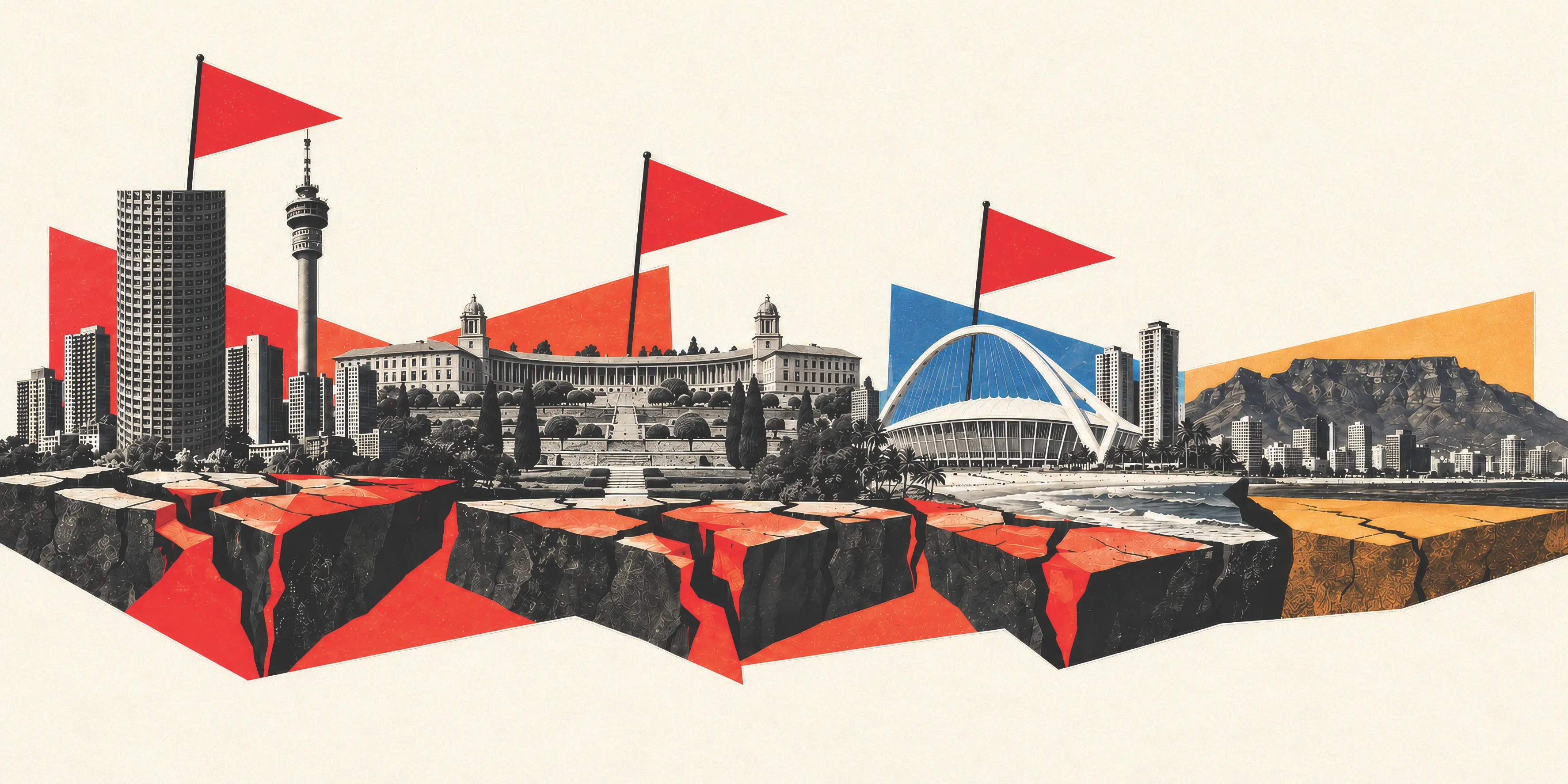
South Africa approaches local government elections on November 4 with a business risk landscape fragmented into distinct zones of opportunity and hazard.
The weakening of ANC dominance, as well as divergent municipal performance, have localised the risk landscape, making it a minefield for business to navigate.
The national government is already increasingly unable to facilitate a uniform business environment. Cities now operate as distinct political economies, differing vastly in governance criteria such as financial health, infrastructure, service delivery, the cost of doing business and political stability.
Sovereign risk and national policies are of course hugely influential for anyone running a business in South Africa, but in the short term, what happens in individual cities may be even more critical. This is because the political outcomes of these elections will feed directly into financial performance, dictating the operating environment for business.

This is the premise of the Paternoster Group’s City Risk Monitor 2026, which assesses the risk profile of municipalities according to four metrics: financial; infrastructure and services; administration and development; and political and coalition stability.
Joburg may be top of the risk list, given the city’s predicament and its role as the economic hub of the country. In terms of economic size, if Joburg were a country it would be in the top 15 African economies by any measure (Gauteng as a whole would be third).
Joburg property developers may eye opportunities presented by Helen Zille’s reform programme, but the challenge facing any incoming administration is immense.
The city has an infrastructure backlog of more than R220bn and only 17 days of cash coverage, and takes 134 days to pay creditors. It has also had eight mayors in the past decade. The opportunity presented by reform therefore sits alongside a significant risk that unreliable coalition partners, municipal and union resistance or broader institutional weakness could prevent a DA-led government from converting political change into drastically improved performance.
Capetonians may consider themselves exempt from the risks posed by the election, but a threat to the DA’s majority may unsettle the certainty with which companies have approached Cape Town as a place for doing business.
Meanwhile, the prospect of an outright MK Party victory in eThekwini raises uncomfortable questions in the city that hosts Africa’s busiest container port. Beyond former president Jacob Zuma, the party’s leadership is constantly in flux, compounding uncertainty in a local economy already under severe pressure from fragile revenue collection.
Complexity and uncertainty

Election day will answer one question: how voters have distributed political authority. It will not necessarily answer a more important question for business: how that authority will be exercised.
In 2021, 66 municipalities produced hung councils, including five of the eight metros. Those numbers are only likely to rise.
For several metros, this critical question will be answered during the ensuing 14 days of coalition negotiations, when key risk variables will be determined. This second layer of political process adds both complexity and uncertainty.
Furthermore, election outcomes, internal repercussions in poor-performing parties and the ensuing coalition negotiations can affect national politics, including the GNU.
While any election carries with it potential turning points, this local government poll has several untested factors at play. For instance, the last time local government elections were held, neither MK nor the GNU existed. Hopes of South African growth were not as realistic. The upsides now hold more potential, and the downsides are more dangerous.
Large swings in these upsides or downsides for different metros will be established as coalitions are formed — and this will affect the outlook for companies in construction, infrastructure, banking, retail and elsewhere.
What this means is that certain metros could effectively appear as over- or underpriced in terms of investment and focus. Businesses may overestimate political stability in some metros, while overlooking opportunities emerging in others.
These new realities introduce coalition combinations, strategic incentives and governing arrangements never before tested simultaneously. For executives, the question is no longer simply who will govern South Africa, but whether metropolitan politics will enable — or disable — the economies where investment decisions are made.
Calland and Stewart are members of the political economy advisory team behind the Paternoster Group City Risk Monitor, which assesses municipal risk and its implications for business across South Africa
Joburg and Cape Town look surprisingly similar on paper, each with about 4.8-million residents. Their consolidated 2026/2027 expenditure budgets are R97.1bn and R88.2bn respectively. Their scale and resources are comparable — but their capacity to turn money into reliable services is not.
The difference really becomes clear in infrastructure investment. Cape Town’s 2026/2027 capital budget is R13.2bn against Joburg’s R8.8bn, despite the Mother City’s smaller overall budget. Cape Town spent almost double on infrastructure maintenance compared with Joburg (R5.9bn to R3.2bn). In 2026/2027, Cape Town plans to allocate about R15 out of every R100 of expenditure to capital projects, compared with just R9 in Joburg.
The cities also differ in how much value is lost through their utility networks. The National Treasury’s 2023/2024 comparison recorded electricity distribution losses of 30% in Joburg, against 11% in Cape Town. These losses weaken utility finances and reduce the resources available to fix infrastructure. They can create a damaging cycle in which deteriorating networks undermine the revenue needed to repair them.
The benefits of political stability are also apparent, both in the municipalities’ ability to attract finance and the type of finance they can attract.
In 2024, Cape Town secured a R2.8bn International Finance Corporation loan with an 18-year term to support projects within its 10-year infrastructure plan. Joburg struggles to attract this longer-term financing.
For investors, the practical question is whether an administration can sustain an infrastructure programme, given the perpetual changes in oversight. Eight different mayors have occupied City Hall in Joburg over the past decade — and these leadership changes create additional risks.
The question, then, will be less about who wins the race for Joburg than who can form a government stable enough to begin tackling the city’s challenges. No party has won more than 33.6% of the vote in Joburg in either of the previous two elections, and it is unlikely that any one party will secure a majority this time.
The way the electoral cards fall will determine whether a coalition government will be stable. The precise numbers will matter a great deal. And as the coalition graphic shows, a number of different scenarios will come into play depending on the cards dealt by the electorate.
So, while Zille’s vigorous campaign seems set to deliver an outcome with the DA as the biggest party in Joburg, the real question will be whether it gets a large enough share of the vote for Zille to find the coalition partners she needs for a new administration to begin turning the city around.

The last time South Africa held local government elections, the MK Party did not exist, and its presence changes the risk landscape of the 2026 election.
MK pursues power through elections, while challenging the legitimacy of institutions that frustrate it. After winning 45% of the KwaZulu-Natal provincial vote in 2024, it tried to prevent parliament from sitting, citing alleged electoral fraud. Its MPs subsequently took their seats, but the party continued to contest the result.
In eThekwini, this approach creates two distinct risks: a victory would give MK control of a major city, while a defeat could prompt another challenge to the validity of the result.
The violence that followed Zuma’s imprisonment in July 2021 demonstrated how a confrontation centred on him could overwhelm the state’s ability to maintain order. That matters when assessing the likelihood of renewed mobilisation around an adverse result.
Victory would raise a different question about how MK uses public authority. It made John Hlophe its parliamentary leader after his removal from judicial office for gross misconduct, and brought former eThekwini mayor Zandile Gumede into its KZN leadership while she was on trial over municipal waste contracts. Gumede has pleaded not guilty.
These appointments bring experience and political networks, but they also indicate MK’s willingness to place figures facing serious institutional findings or proceedings in positions of authority.
For businesses dependent on eThekwini’s water, infrastructure and contracts, the election carries risk on either side of the result: disruption if the outcome is rejected, and uncertainty over administrative decisions and legal constraints if MK governs.

The Paternoster Group’s City Risk Monitor identifies low institutional risks in Cape Town, providing a favourable starting point. Nevertheless, Cape Town faces pressures from rental prices, municipal charges and growing demand for housing and basic services.
The municipal tariff dispute has created a concrete challenge to the DA’s governance narrative and in 2026, the Western Cape High Court invalidated aspects of the city’s fixed cleaning, water and sanitation charges.
The Constitutional Court recently delivered a scathing judgment, commonly referred to as the Tafelberg case, regarding the lack of housing opportunities in the inner city and therefore the continuation of apartheid-based spatial injustices. The public protector also made a range of adverse findings against Cape Town on service delivery failures in townships.
These episodes give opposition parties an opportunity to contest both the affordability and design of municipal revenue, as well as the gap between institutional performance and residents’ experience in some parts of the city.


