

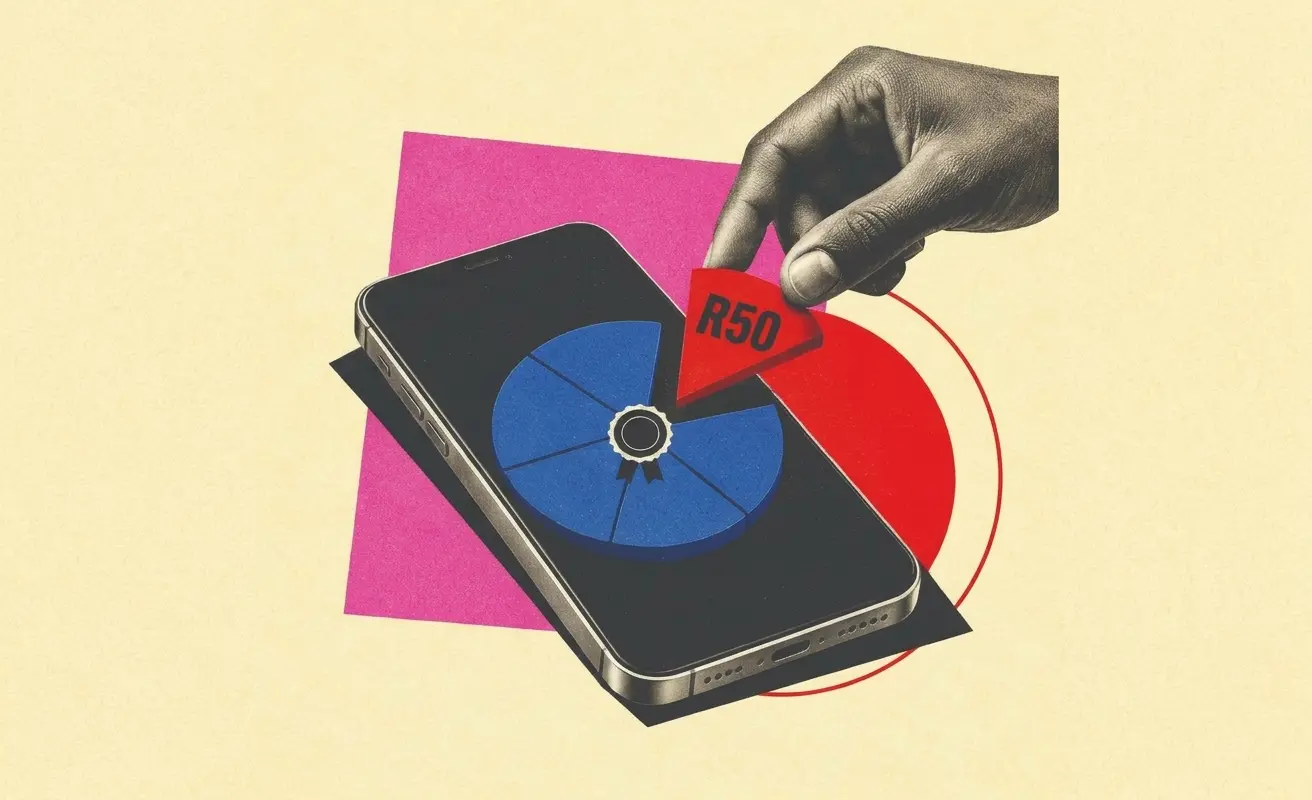
R50 sadly does not buy much in South Africa anymore. But in the world of tokenised stocks, it is the typical price of a slice of Nvidia, whose stock price has recently surged above R3,600 a share.
The most common tokenised stock purchase we see at Luno is roughly R50. The median sale is about R75. Since we started offering tokenised stocks, the number of customers using them has grown tenfold, and about 80% of those who have bought are still holding. Their largest positions are in tokens tracking Tesla, Nvidia and Strategy.
These are not hedge fund trades. They are small, regular purchases by people who until recently had no practical way into these companies at all. For generations, wealth creation in South Africa was guarded by high walls: steep share prices, broker minimums, offshore paperwork, and foreign exchange fees that wiped out small deposits before a single share was bought. If you did not have a lump sum, you watched from the sidelines while global giants compounded wealth without you.
Tokenisation brings that price of entry down to whatever a person can afford to put at risk.
The pattern in our data actually looks a bit more like saving than speculation. Buy volume is about 2.1 times sell volume. Average balances tell the same story. In the early months, the typical customer held about R650–R800. Within a few months that rose to between R3,500 and R4,000, and it has stayed in this range, even as the customer base grew tenfold.
A tokenised stock represents a share held in custody. It is not the share itself, and it carries no vote. Prices move, and a R50 position in Tesla can fall as easily as it rises. But for everyday South Africans building wealth, voting rights at an AGM thousands of kilometres away matter far less than having a ticket to the game in the first place.
This shift points to something much bigger than just a new product feature; it signals a fundamental change in investment patterns. When public ledgers and tokenisation allow anyone to fractionalise bonds, gold, equities or even property, the traditional asset management model faces a quiet reckoning. If a balanced, diversified global portfolio can be built R50 at a time on a smartphone, one might ask where the traditional gatekeepers fit into the equation.
The technology is proving that the appetite to save and invest in South Africa is real, access to this may just have been locked out by legacy friction. For the institutional players, adapting to tokenised infrastructure is no longer just a forward-looking experiment — it may very well be a matter of survival.
For a country where household savings are thin and most people have never owned a share, that would be a genuine widening of access for South Africans to build personal wealth.
De Wit is country manager for Luno South Africa


