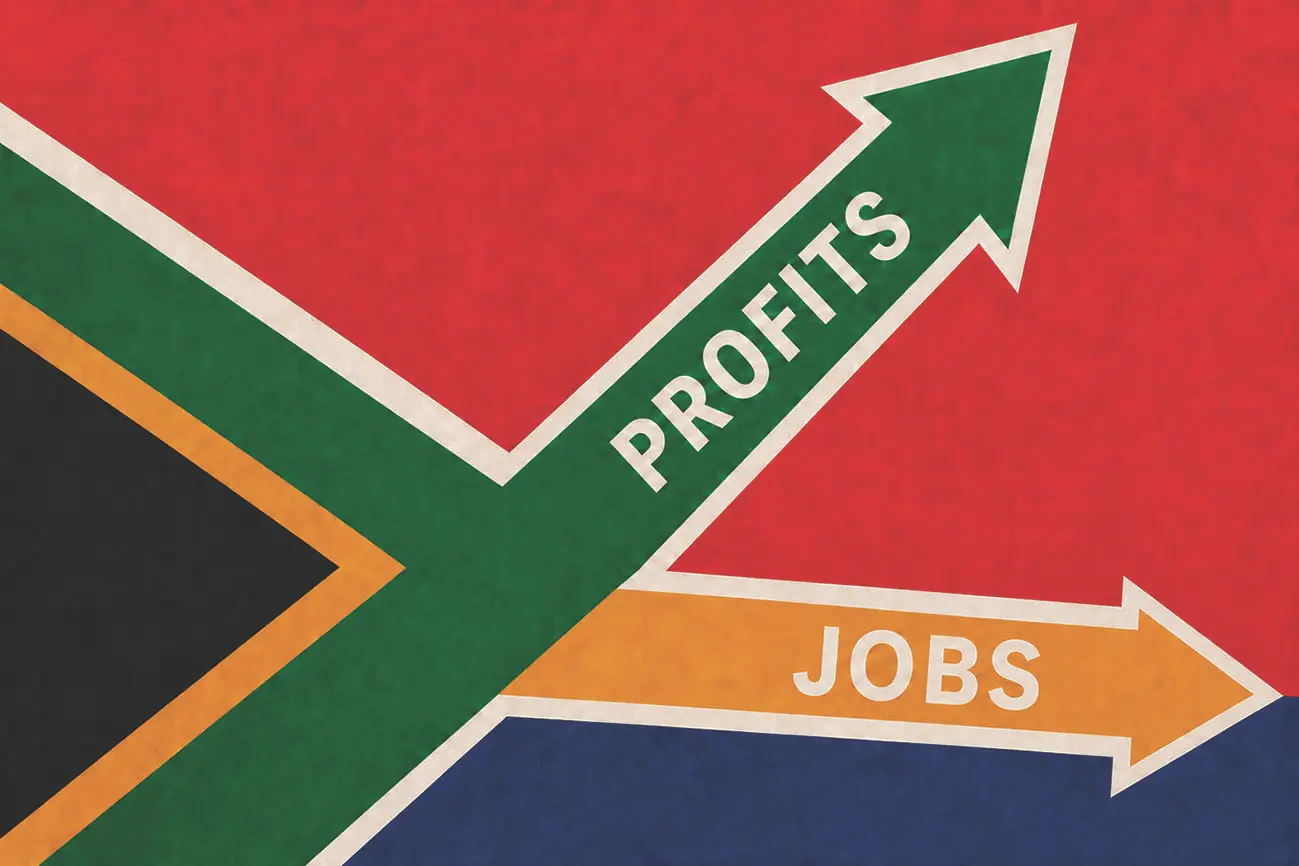
There’s no doubt that unemployment is one of the most significant challenges facing South Africa — a byproduct of dismal economic growth. And yet the government itself stands in the way of job creation.
The issue goes back to 2008, when the labour market essentially stalled after the global financial crisis; on a per capita basis, employment today is lower than it was 18 years ago.
The main reason is the collapse of economic growth. Between 2002 and 2007, the economy grew by 4.6% on average, adding 2.1-million new jobs, compared to labour force growth of 1.5-million. As a result, the official unemployment rate fell from 29.7% to 23.5%.
To illustrate the impact of the growth slowdown since 2008, we can calculate how many jobs would have been created if growth had continued at its long-term trend. Between the start of democracy and 2008, each percentage point of annual growth generated about 60,000 new jobs. Had the economy continued at its pre-2008 growth rate of 3.6%, about 500,000 more people would have been employed now.
Instead, since 2010 growth has averaged only 1.3%, delivering slightly more than 150,000 jobs a year, compared to annual labour force growth of more than 400,000. Despite an increase in jobs per percentage point of growth to about 130,000, the number of unemployed has risen by 230,000 a year, and the population grew by 1.4% a year, or more than 750,000 people in 2025 alone.


Sustained job creation depends on two things: faster economic growth and a higher capacity for the economy to absorb labour.
One way to achieve both would be getting rid of the regulations that make it unattractive for firms to hire workers. Since 1994, the average number of employees per registered business has fallen from 180 to about 30. Firms are choosing to stay small or keep their headcounts from growing because, as the OECD shows, a range of South African regulations raise compliance costs and make it hard for firms to expand.
The best example is broad-based BEE (BBBEE) regulations. They create an incentive for firms to stay under R10m turnover and 50 employees and imply ongoing compliance costs for firms of different sizes of between 1% and 5% of turnover. According to our survey, almost 50% of firms report reduced reinvestment and more than 40% report having reduced new investment because of BBBEE regulations.
Removing the constraints
Another way to raise employment would be to support informal employment growth. Informal employment represents a fifth of total employment and has been responsible for about a third of the jobs created since 2010. But South Africa’s informal sector is smaller, proportionally, than those in other emerging markets.
Researchers from the Harvard Growth Lab attribute this, among other things, to increasing state interventionism, despite a collapse of state capacity. They highlight government rules that incentivise urban sprawl, thereby raising transportation costs and reservation wages, in addition to municipal red tape, disintegration of public infrastructure and poor service delivery, and crime and extortion rackets. Prof Haroon Bhorat of the University of Cape Town also argues that municipal bylaws and restrictive licensing rules suppress the informal economy.
Labour supply is another challenge. Metrics of the quality of South African education show that it remains critically low and unequal by global standards. A Harvard study by Banerjee and co-authors suggests a mismatch in skill requirements in the formal sector and what the education system delivers as a key reason for the increase in unemployment. Our research, in line with estimates from the International Monetary Fund and OECD, also shows that there has been a decline in the contribution of labour quality to potential growth in South Africa.
South Africa stands out for having one of the highest unemployment rates in the world, now at almost 44% based on the broad measure. About half of the population is receives government social grants. While grants represent an important social safety net, reliance on grants rather than employment fosters structural welfare dependency. It also increasingly threatens long-term fiscal sustainability as a stagnant tax base struggles to fund growing social wage demands.
Getting South Africa’s growth rate to the 3% many economists hope for will not be sufficient to reduce the unemployment rate. To sustainably bring down unemployment, we need much faster growth and a higher employment intensity of economic growth.
With unemployment arguably South Africa’s most important socioeconomic challenge, it is inconceivable that there is so little tangible policy effort being directed at removing constraints to employment creation. The tragedy is that many of the policy reforms currently being debated would make it harder and more expensive for firms to hire.
Steenkamp is CEO at Codera Analytics and a research fellow with the economics department at Stellenbosch University. Horn is a labour economist at Codera