
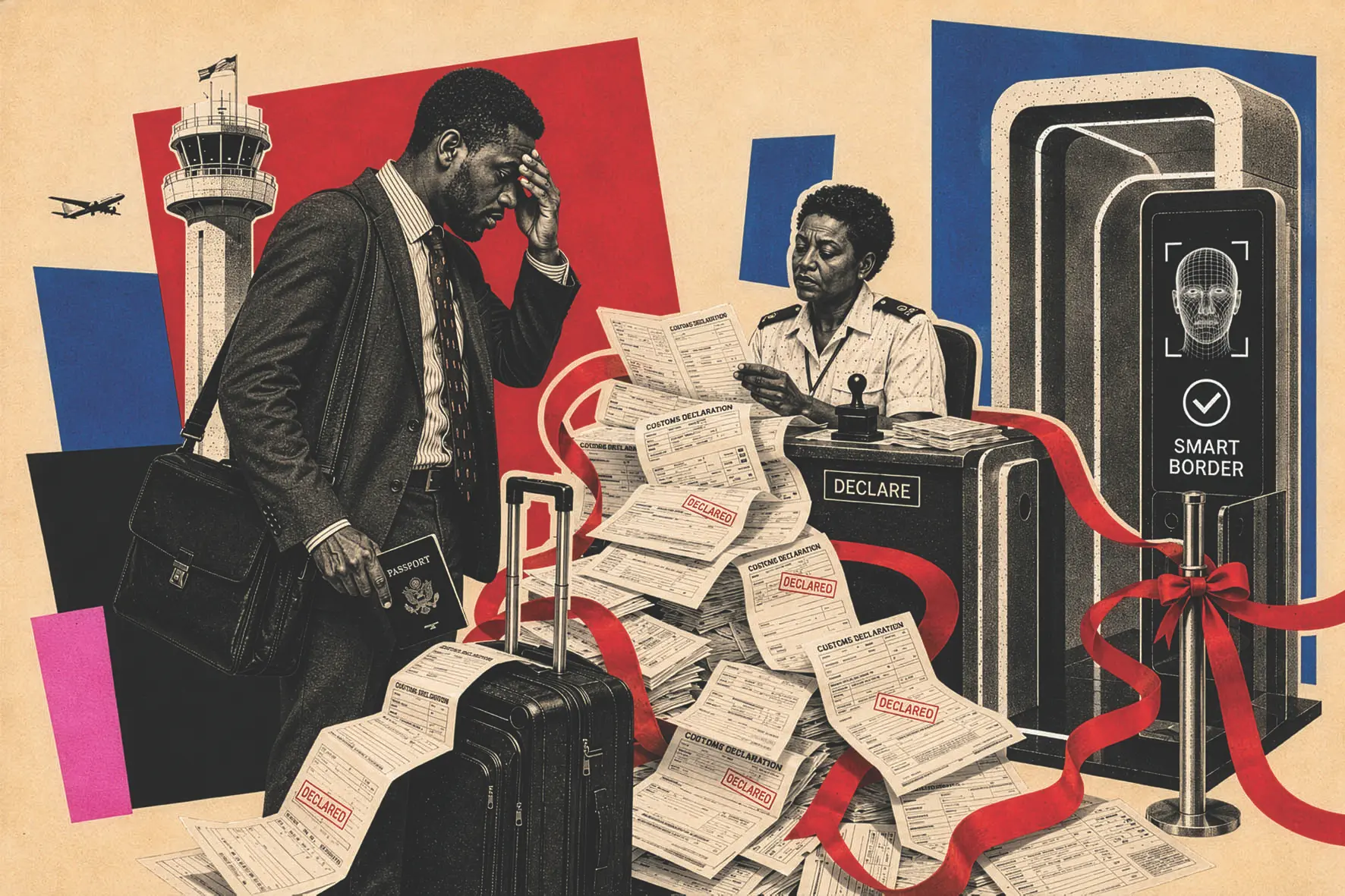
South Africa’s border tech rollout has arrived in two clashing halves.
Since July 1, every traveller has faced the South African Revenue Service’s (Sars’s) mandatory declaration system that’s drawn sharp criticism for confusing design, unclear liability and patchy enforcement.
High-profile figures including Magda Wierzycka and Mike Ratcliffe publicly vented their frustration.
Then, just weeks later, President Cyril Ramaphosa unveiled the shiny new electronic travel authorisation (ETA), hailed by the department of home affairs as a “quantum leap forward” for tourism and security.
The result is a lopsided picture: one system stumbling through real-world confusion, the other basking in launch-day celebrations, leaving travellers caught between friction and fanfare.
For a start, there is the full declaration that every traveller must complete: the South African Traveller Management System (SATMS), the backbone of border compliance. The system demands passport details, routes, companions, addresses, goods descriptions and currency amounts. Anything above R100,000 requires prior Reserve Bank authorisation. Failure to declare can mean penalties, seizure, or detention.
And when the digital system fails, travellers fall back on the seven‑page manual form that still lurks behind the promise of “smart borders”.
The traveller goods declaration shows how “facilitation” quickly turns into enforcement. It logs tariff codes, duties, VAT, provisional payments and currency declarations, whether for individuals, companies or on behalf of someone else. Customs officers decide detention or release based on compliance.
Then the Bank insists that “travellers remain subject to the applicable exchange control rules and reporting requirements irrespective of the platform used to make customs or traveller declarations”.
It adds that the Bank “does not currently regard the Sars traveller declaration system as part of the exchange control approval framework administered by authorised dealers”, who must still comply with the Currency & Exchanges Manual.
Resident individuals may still use the R2m annual single discretionary allowance, and exports of personal effects remain subject to existing rules.
“The financial surveillance department was not involved in the development or implementation of the system,” says the Bank. It adds: “We have not undertaken an assessment of the Sars traveller declaration system.” However, it “continues to collaborate closely with Sars, sharing information and monitoring cross-border movements”.
David Frost, CEO of the Southern Africa Tourism Services Association (Satsa), says: “The most significant challenge reported by members has been change management rather than the declaration process itself.”
Operators and agents had to adjust planning, documentation and client communications to accommodate the new pre‑travel step. Frost explains: “The immediate priority was ensuring travellers understood what was required before arriving at the border.”
Concerns on rental vehicle allocations and availability of information before collection were flagged, but Frost says: “They have not, however, translated into widespread operational issues, and Satsa has not received reports that vehicle substitutions are creating significant challenges in practice.”
Frost expects that declarations will be become a normal part of the process. “As awareness grows and the new requirements become part of standard pre‑travel communications, the declaration will become a routine element of planning cross‑border self‑drive travel.”
Stéfan van der Merwe, CEO of Sure Travel, says: “No real disruption has been experienced, as authorities allow travellers to complete the declaration on arrival.” He warns: “If it were policed aggressively, it would become a problem.”
The Sars clause that anyone completing a declaration on behalf of another “takes responsibility for accuracy” has pushed agents away from assisting clients. Van der Merwe says this clause “discourages agents from doing that as it could lead to legal liability”.
He says: “Agents often lack access to all the necessary information … especially equipment with serial numbers. At this stage we are mainly focusing on educating customers to complete it themselves.”
Van der Merwe says “system uptime will become an issue as the app gets busier, given that travellers en route often have limited internet access”.
Early reaction from high-profile travellers was largely critical.
Ratcliffe, owner of Vilafonté, a red wine estate, was among the first in early July on X to describe the SATMS MobiApp as “pathetic, counterintuitive, poorly designed and frustrating”, warning that it risked becoming “a huge frustration for almost everyone & provide impediment to tourism”.
A few days later, on July 10, Sygnia CEO Wierzycka posted on X: “I’m not sure what to declare on leaving SA. In desperation I have taken photos of my suitcase contents with CT skyline in the background. Can we upload photos? Sars, please clarify!”
She followed up by posting: “I am deeply uncomfortable with Sars knowing my precise travel plans ahead of time. Why? There are security issues involved for some people. I have visited 78 countries. None require this.”
Just weeks later, the story shifted. On August 12, Ramaphosa cut the ribbon on South Africa’s ETA at OR Tambo International Airport, billing it as a flagship reform to modernise visas and speed up entry.
Home affairs minister Leon Schreiber called it “a quantum leap forward … unlocking economic growth through tourism, investment and legitimate travel, and landing a decisive blow against visa fraud and illegal immigration”.
Travellers register online, scan their passport, upload a selfie, pay and receive approval within 24 hours. At the border, an electronic system verifies faces against passports, with Schreiber insisting “the face of the traveller becomes the key that determines whether they may enter, rather than physical documents that can be manipulated”.
The ETA also allows lawful visitors to extend stays by 90 days, a feature Schreiber said will “significantly boost tourism revenues”.
Over the coming months, the ETA will become compulsory for short‑stay visa‑required travellers, while visa‑exempt visitors can opt in for faster queues.
“The ETA is the embodiment of our commitment to turn South Africa into a world leader in smart and secure migration management,” Schreiber promises.


