
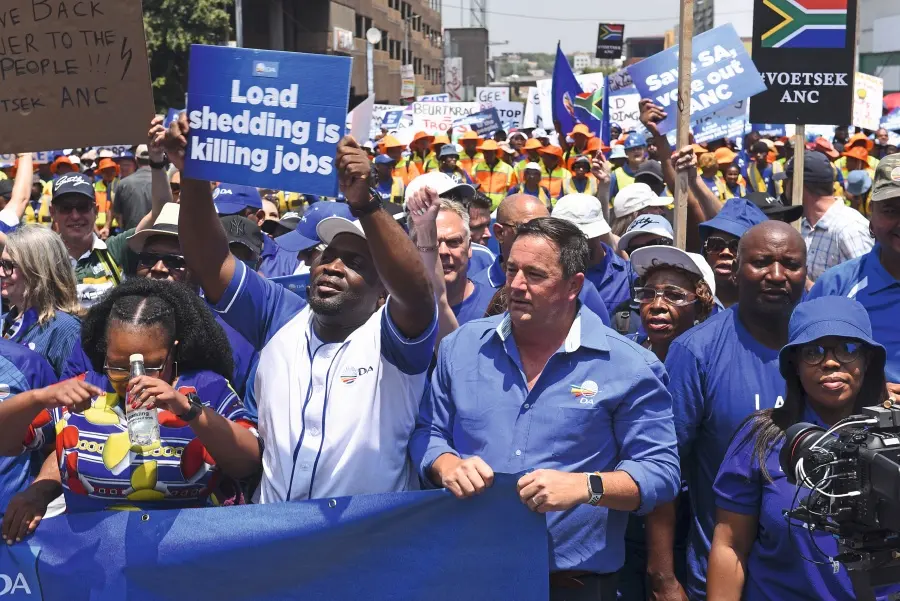
I’d like to pick up on an idea proposed by Colin Coleman, former Goldman Sachs partner and now adjunct professor at Columbia Business School, on the weekly podcast we produce called ListenUP!.
Coleman was our guest this week, and we briefly discussed the November 4 local government elections. My regular podcast mate, Mark Barnes, made the point that these elections are crucial not only as a political event, but as an opportunity to begin remedying the financial and managerial disaster that now characterises so many municipalities.
Coleman added another thought: there are perhaps 5-million broadly centrist voters who are politically “homeless”. And his interesting suggestion is that the answer may not be the creation of a new centrist party but an enduring and “calibrated equilibrium” between the ANC and DA.
This deserves examination. But first, one thing about local government elections is worth remembering: they have been astonishingly good indicators of the direction in which national politics is travelling.
In 2006 the ANC won 66.3% in the municipal elections; in the 2009 national election it won 65.9%. In 2011 it got 62% locally; in 2014 it got 62.2% nationally. Then the warning lights started flashing.
In 2016 the ANC crashed to 53.9% locally before recovering to 57.5% nationally in 2019. In 2021 it fell below 50% nationally for the first time, getting 45.6% in the municipal poll. Three years later it got just 40.2% nationally and lost its parliamentary majority.
So local elections don’t tell you precisely what will happen at the next national election. But they have been excellent political seismographs: 2016 foretold the age of urban coalitions; 2021 foretold the end of ANC majority rule.
What, then, about Coleman’s 5-million homeless centrists?
Five million is impossible to establish precisely, but the order of magnitude is entirely credible. Ipsos found earlier this year that an extraordinary 47% of South African adults say no political party represents their views, despite the country having more than 500 registered parties. Yet 64% said they wanted to vote in the local elections. Among registered voters, Ipsos had the ANC at 38% and the DA at 22%.
So the “homeless” population is clearly enormous. Whether 5-million are actually “centrists” is another question. South Africans do not arrange themselves politely along a European left-right spectrum.
But we can see what is happening. In absolute numbers, the ANC won 11.44-million votes in 2014. In 2024 it won only 6.46-million. In a decade, almost 5-million ANC votes disappeared.
Some migrated. The EFF provided one destination; MK provided a spectacularly successful one in 2024. But many simply stopped voting. Research by Marcel Paret and Carin Runciman into voting behaviour in five metros found that among black voters who had previously supported the ANC, 18% moved to abstention in 2021 while 9% moved to another party. More than 40% of those leaving the ANC for abstention cited political disillusionment or assessments of party performance.
That seems intuitively right. Voters on the ANC’s more radical flank have the EFF and MK available to them. But a substantial number of more moderate former ANC voters appear unable or unwilling to make the psychological jump to the DA, which, fairly or unfairly, is still perceived by many as a “white party”.
And here is the extraordinary consequence. While the ANC was losing 5-million votes between 2014 and 2024, the DA didn’t gain 5-million. It didn’t gain one 1-million. It lost votes.
The DA got 22.2% (4.09-million votes) in 2014; 20.8% (3.62-million) in 2019; and 21.8% (3.51-million) in 2024. Its remarkable 26.9% result in the 2016 local elections now looks like an excursion rather than a breakthrough.
So, the ANC has a blood-loss problem. The DA has a ceiling problem. Hence, Coleman’s “calibrated equilibrium” becomes interesting. Each party potentially possesses what the other lacks.
An enduring ANC-DA arrangement could help cauterise the ANC’s loss of moderate voters by giving them some reassurance about economic management, institutions and competence. And it could provide the DA with something it has never managed to achieve on its own: a bridge into an electorate prepared to approve of a DA government but not yet prepared to vote DA.
The ANC needs a tourniquet; the DA needs a ladder.
There is, unfortunately, one rather large difficulty: the ANC.
Helen Zille discovered this during the negotiations after the 2024 election. According to her account, she, Fikile Mbalula and David Makhura had made substantial progress towards a “stability pact” in hung metros. One version would effectively have seen the DA leave an ANC administration alone in Ekurhuleni while the ANC left DA mayor Cilliers Brink alone in Tshwane.
Instead, the ANC supported the motion that removed Brink.
Zille claimed the Gauteng ANC had effectively defied or outmanoeuvred the national leadership; the ANC countered that its national working committee had authorised Brink’s removal. Either explanation rather proves the problem.
What exactly does an agreement with “the ANC” mean when its national, provincial and regional structures can want different things?
The argument against Coleman is formidable. A calibrated equilibrium requires something capable of being calibrated. The DA is highly centralised and disciplined; the ANC is closer to a sprawling political federation containing ideological factions, provincial power centres, branches and patronage networks. Getting the two to maintain a long-term bargain could resemble attempting ballroom dancing with an octopus.
But the argument in favour is also powerful: what is the alternative?
The November election should tell us much. If the DA finally breaks out and gets, say, 28%, then perhaps its ceiling was not a ceiling after all, and the possibility of eventually becoming the dominant governing party becomes real. If the ANC stabilises around 40%, it may have stopped the bleeding.
But if the DA remains around 22%-24% while the ANC slips further into the 30s — which seems at least as plausible — then the arithmetic starts imposing its own logic.
Neither can get where it wants to go without finding voters it has repeatedly proved incapable of finding. At that point the two parties may discover that they do not merely tolerate each other. They need each other.


