

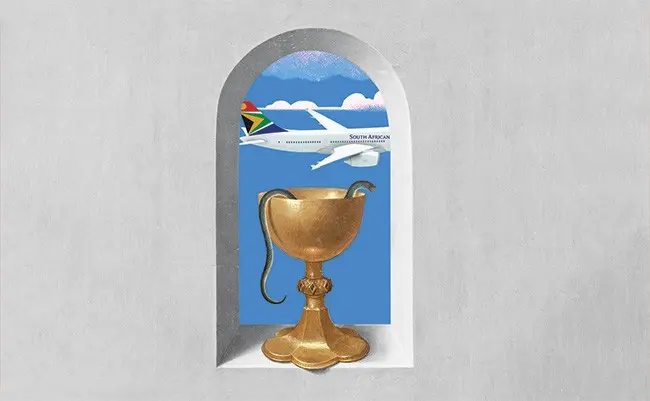
If you’re not one of those who still pages through newspapers, you might have missed an advert two Sundays ago, calling for applications for the role of CEO of SAA. Evidently, it’s a job that’s not for the faint-hearted; just reading through the requirements is exhausting.
For a start, the successful candidate would “provide strategic leadership and assume full accountability for the safe, efficient, financially sustainable operation and growth of the airline”. (Airlink staff might note that the job requirements don’t mention anything that would preclude flying within 12m of a stadium holding 90,000 people. In other words, a strong risk appetite is a prerequisite.)
Oh yes, SAA’s new boss will also be required to go where few have been in years. This is because the advert says the CEO will be responsible for “leading the airline to sustain profitability and best-in-class performance in safety, reliability, cost efficiency, customer experience and operational resilience”.
It’s the striking reference to “profit” which will be a tall order, since SAA has been burning cash with all the abandon of a Tshwane municipal official in a Maserati dealership. For the year to March 2025, the airline claimed it made R155m profit.
But that’s just accounting footwork; actually, it made a pretax operating loss of R317m, which only vaulted into the black thanks to the R1.17bn it made by selling one of two lucrative landing slots at London’s Heathrow Airport.
Selling that slot was controversial, but in its annual report SAA said it had no option. Once an equity deal to sell the airline to Harith General Partners fell through in March 2024, it had to “identify ways to compensate for the lost funding”, and the London slot was a quick win.
The cash flow statement demonstrates how fragile the airline is. SAA had a net cash outflow of R44m from its operating activities — a heap better than the R505m outflow the previous year but hardly a sign of rude health.
If you’re thinking of applying, you might want to skip the bloody auditors’ report. There auditor-general Tsakani Maluleke kicks off with a disclaimer that she was unable to obtain sufficient audit evidence that SAA is a going concern “due to the significance of the material misstatements”.
And don’t think you’ll be able to do the CEO job without government interference. You’d be required to “ensure disciplined delivery against board and shareholder mandates, regulatory obligations and long-term sustainability objectives”.
Which isn’t encouraging in an airline with a history of government meddling, most notoriously when it was chaired by Dudu Myeni, former head of the Jacob Zuma Foundation.
Well, as luck would have it, there was one arm of the SAA group that did actually make a profit: Air Chefs, the airline catering business which has been around since 1986. Air Chefs is no longer just a business flipping rolls with frozen polony at passengers. Today it provides in-flight meals to domestic and international airlines, supplies airline lounges and charter flights and offers ready-made meals to contract caterers. Last year, Air Chefs’ revenue rose 27% to R375m, as it “returned to profitability”. For the year to March 2026, insiders say this is set to rise to R500m, while the firm reports record profits.
When John Lamola quit in April, it seemed appropriate that Matshela Seshibe, who had led Air Chefs, be appointed SAA’s acting CEO. It was an easy move, since he had been heading the airline’s “liquidity crisis” committee for months.
Then, two weeks ago, Seshibe was placed “on special leave with immediate effect” pending an investigation. This came in the wake of an anonymous whistleblower report, which accused him of various things, according to sources who spoke to the FM.
The straw that broke the camel’s back, insiders say, was the accusation that he broke procurement rules by applying the wrong delegation of authority when he signed off on hiring staff. Apparently, Seshibe used the SAA process, that of the holding company, rather than that of Air Chefs.
So here’s where it gets interesting. Just one week after he was suspended, SAA rushed out that advert to fill the CEO role, with a closing date of September 6 — this Sunday.
Given how whistleblower reports are being weaponised in state-owned companies to strategically sideline people such as Patrick Dlamini at the Public Investment Corporation, you have to wonder if the timing of this CEO appointment was designed to eliminate Seshibe from the running. It’ll be intriguing to see if he applies anyway.
As it is, the worm has turned. In a world where whistleblower reports are currency, it’s not the biggest surprise that a new one has emerged from “concerned employees of South African Airways” — only, this one falls in Seshibe’s favour.
Sent to SAA’s board, the letter called for Seshibe’s “immediate reinstatement” since he had begun to “stabilise the airline” and restore confidence. “An allegation concerning hiring irregularities does not, in our view, warrant special leave.
At most, if proven, it may attract a written warning,” they say. “To remove an ethical, performance-focused leader on this basis, while stalling a proper investigation into far graver failures at [the SAA] group, is very concerning.”
What is clear from these conflicting whistleblower reports is that there might be a “new“ SAA, but it is as riven by factions as ever.
And the battle for who controls the purse strings of a company that spends R9.5bn a year on everything from fuel to ground handling is as fierce as it has ever been.


