

The JSE’s dozen-odd property stocks that generate 100% of their earnings in pounds and euros have been largely overlooked by investors over the past two years, while a stronger rand and a return to inflation-beating dividend growth helped propel South Africa-based real estate investment trusts (Reits) to seven-year highs.
One-year total return figures confirm that the laggards among the JSE’s 42 real estate counters are dominated by rand hedge counters. However, a more recent comparison suggests that offshore counters are slowly but surely starting to play catch-up. In fact, year to date (January to July), three offshore stocks pipped the all property index’s 7% total return: Western Europe-focused Hammerson at 19.2%, UK-based Supermarket Income Reit at 9.5% and Eastern Europe mall owner Nepi Rockcastle at 8%.
Most analysts are betting on South Africa Inc stocks continuing to outperform their offshore counterparts over the next six to 12 months on the back of shored-up balance sheets and improved trading metrics in underlying retail, office and industrial portfolios. Metope Group senior investment analyst Curwin Rittles says while the operational performance of offshore-focused counters, particularly those with exposure to Eastern Europe and Iberia, has also improved, “their relative total return outlook is currently less compelling than many domestic-focused names”.
Still, Rittles tells the FM that the gap has narrowed. He adds: “Should offshore companies continue to see a recovery in performance metrics, alongside a more supportive interest rate environment, the case for increasing exposure to selected rand hedge property stocks will become progressively stronger.”
Meanwhile, the latest results from offshore property stocks certainly point to an improved earnings and dividend growth outlook. In recent weeks, Hammerson, Lighthouse Properties and Nepi Rockcastle all upgraded their earnings growth projections for 2026. Hammerson declared an impressive 22% year-on-year increase in dividend payouts for the six months to June and raised its growth guidance for the full 2026 financial year to 27%. That comes on the back of an extensive five-year restructuring, which has left the company with a core portfolio of 10 destinations across the UK, Ireland and France.
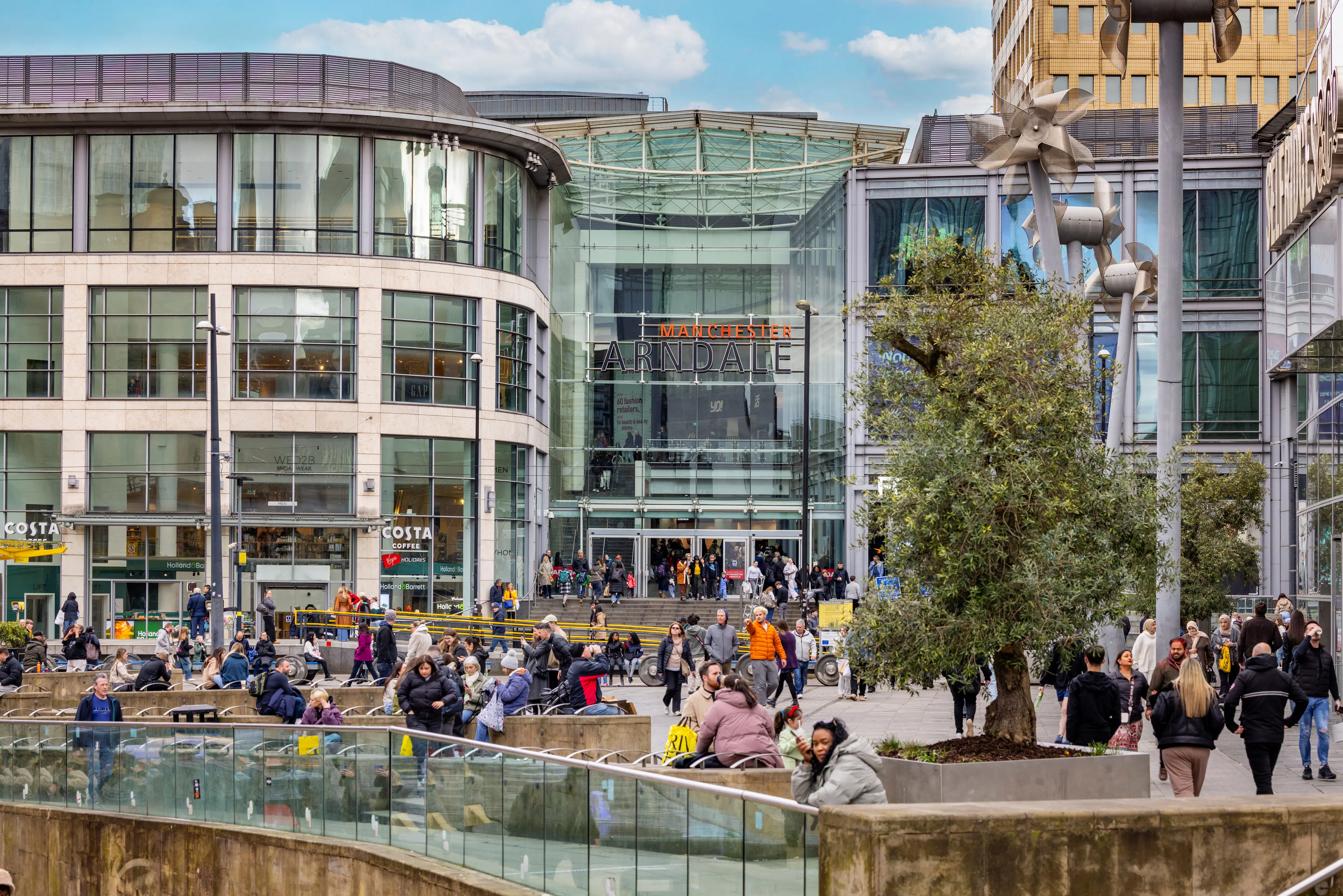
Hammerson’s improved fortunes in the first half of 2026 have been supported by a strong uplift in sales, foot count and rentals on lease renewals across its retail destinations. Last month, the company also splurged £218m to acquire 50% of Manchester Arndale. The 120,000m² mixed-use property is Hammerson’s first major acquisition in more than a decade, which CEO Rob Wilkinson said signals an important turning point for Hammerson after a multiyear consolidation period.
Like most of its UK retail-focused peers, Hammerson has in recent years faced the rise of e-commerce, as well as pandemic-induced store closures and tenant insolvencies, which led to higher vacancies, falling rentals and excessive valuation write-downs.

Lighthouse last month also revised upwards its dividend growth guidance for its full 2026 financial year, from 6.9% to 8.7%. The company, which owns a €1.48bn portfolio of 12 shopping centres across Spain, Portugal and France, reported healthy trading metrics in its shopping centre portfolio for the six months to June. Tenant sales and foot count increased by 7.9% and 3% respectively, while the vacancy ratio came to a negligible 1.1%, which CEO Justin Muller ascribed to the company’s “active asset management approach and a carefully targeted leasing and capital investment strategy”.
Sector heavyweight Nepi Rockcastle recently released an equally upbeat set of interim results and raised its distributable earnings growth guidance for the 12 months to December from 3% to 3.5%–4%. That comes on the back of better-than-expected tenant sales and strong rental uplifts in the six months to June across its portfolio of 60 shopping centres. The company’s portfolio is worth a hefty €8.4bn and spans eight Eastern European countries, with its biggest exposure in Romania, Poland and Bulgaria.
Nepi Rockcastle, which is the JSE’s largest property counter with a market cap of R107bn, was a market darling for much of the past decade. But in the past two years, the stock has disappeared from fund managers’ lists as most gravitated towards domestic counters.
In a surprise move, Nepi Rockcastle acquired MegaPark Barakaldo in Bilbao for €252m, which, at 120,000m² (of which it owns 81,000m²), is the largest retail destination in northern Spain.
It’s the first time in Nepi Rockcastle’s 19-year history that it has set its sights beyond its traditional market of Central and Eastern Europe (CEE), a move that has prompted independent analyst Keillen Ndlovu to place the stock at the top of his offshore property picks.
Ndlovu tells the FM that the strategy to diversify its portfolio into Western Europe significantly lifts Nepi Rockcastle’s longer-term growth prospects. He says management’s plan to convert the company to a Reit structure next year further supports the investment case, as it should place the stock on the radar of more global fund managers and income-chasing investors. “Adopting a Reit structure will also make it easier to compare Nepi Rockcastle with European retail-focused Reits such as Unibail-Rodamco-Westfield and Klépierre, both listed in France, and Amsterdam-based Eurocommercial Properties.”
At this week’s level of about R150, the company is still trading at a slight discount of about 3% to its NAV of €8.16 a share, which Ndlovu notes places the stock at an attractive forward dividend yield of about 7.8% (in euros).
According to CEO Marek Noetzel, Nepi Rockcastle’s entry into Spain was prompted by limited new acquisition opportunities in CEE, which has hampered its growth ambitions. Speaking at the interim results briefing at the JSE last week, he said when the company was founded in 2007, the former communist bloc still offered huge development potential.

But nearly 20 years later, the size of the company’s balance sheet has ballooned to such an extent that CEE is now becoming too small. Noetzel stressed that Nepi Rockcastle is by no means exiting the region. It has an €826m development pipeline in the region, with plans for two new shopping centres, two residential developments and several extension and refurbishment projects.
“However, there are fewer investment opportunities … and the type of property we want to buy is not coming to the market as often as we would like. It’s becoming more difficult to scale up, so we had to look elsewhere.”
But why Spain? Noetzel said they looked at France and the UK, but both offered less attractive pricing and returns. Besides, Iberia is double the size of Poland and has in recent years overtaken CEE in terms of GDP and consumption growth. He pointed to Spain’s economy, set to grow at an estimated 2.4% this year, well ahead of CEE’s 1.85% and the wider eurozone’s 0.9%.
While Spain has roughly half the population of CEE (49-million vs 95-million), Noetzel said its purchasing power (euro spend per inhabitant) is 50% higher than that of CEE.
He conceded that other retail property investors are also trying to cash in on Spain’s vibrant consumer market, including JSE-listed Vukile Property Fund and Lighthouse, which have aggressively scaled up their Iberian exposure in recent years. But Noetzel maintained there is still plenty of opportunity to acquire shopping centres at accretive yields in both Spain and Portugal, typically around 7%.
“Besides, there is competition everywhere. Our competitive advantage is that we are cash buyers.”
Nepi Rockcastle has a war chest of €1.2bn and a conservative loan-to-value ratio of 33.1%. Noetzel added that the move into Spain will also enable a cross-country migration of Nepi Rockcastle’s expansive footprint of CEE tenants into Iberia. The focus will be on large, dominant assets. “Go big or go home is our strategy. Iberia is a long-term game for us. I won’t be surprised if we get to an asset value of €2bn in the next five years,” he said, and hinted that Italy could be next on the company’s Western Europe expansion trail.


