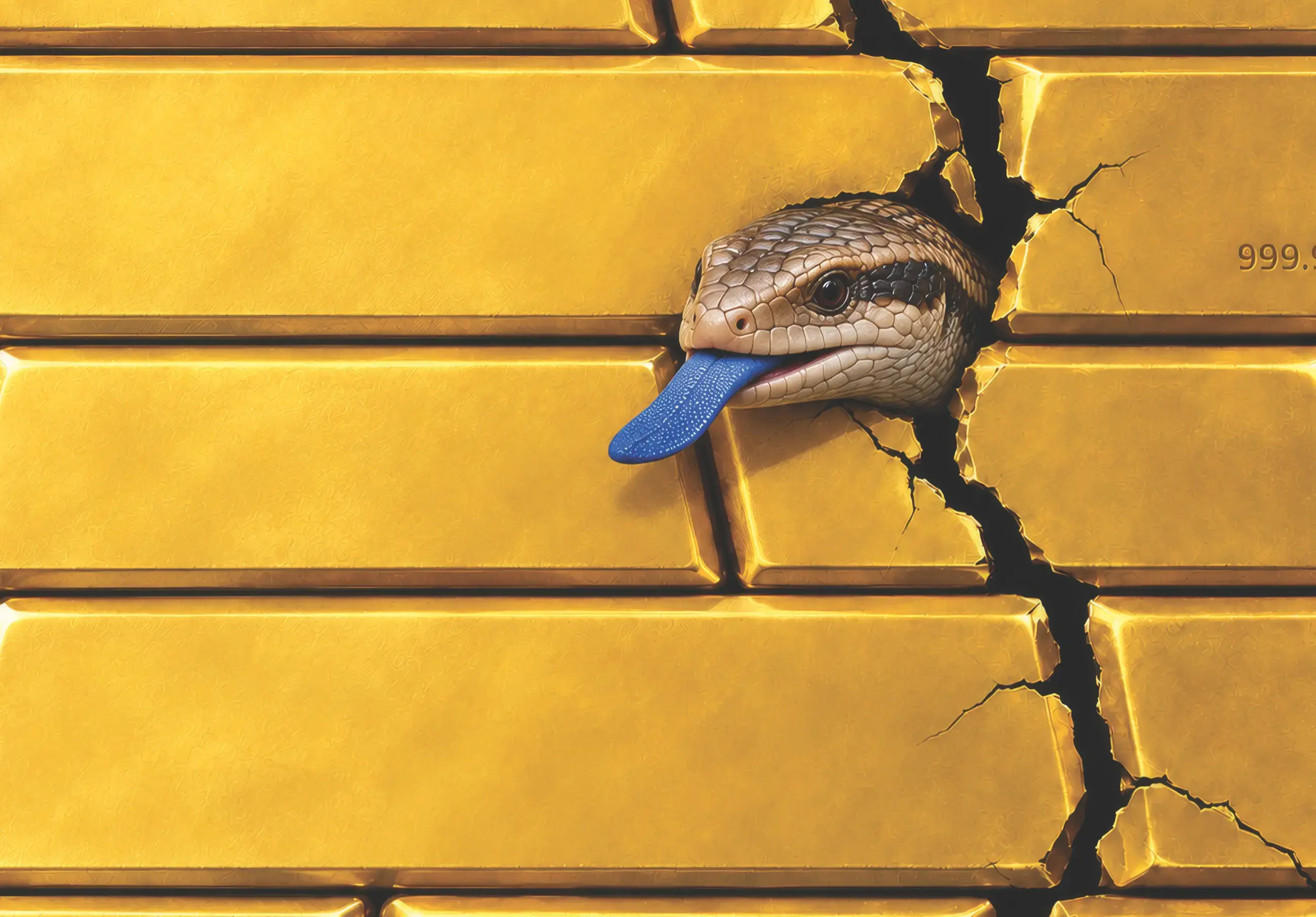
The fate of the blue-tongued skink, a type of lizard, might not have ranked among Harmony Gold CEO Beyers Nel’s concerns a year ago. Yet the discovery of a dead one at the group’s Eva copper project in Queensland, Australia, in September has resulted in a reshuffling of priorities. Because in addition to being colourful, skinks of this species are also endangered.
For a project, stumbling on rare fauna often means one thing: delay. Speaking to the FM in September from the firm’s Randfontein offices, Nel said the company sprang into action, notifying the Australian government immediately — an act of self-regulation he believes will win Harmony “some goodwill”.

Nonetheless, government authorities responded by ordering Harmony to pause site clearance at Eva. Project development was allowed to continue where the site had already been prepared, but Harmony is now tasked with finding ways to preserve the habitat where the skink was discovered. Harmony hasn’t lost its all-important environmental authority permit, but it can be legally stopped by the government. What happens to a rare lizard occupies the thoughts of Australia’s federal government, it would appear.
The longer the hiatus, the more likely it is that there will be schedule and cost slippages, though Harmony is yet to announce schedule changes.
It is a familiar story for mining firms as they race to build more production across the metals complex.
Sightings of short-tailed chinchillas caused delays of more than three years at Gold Fields’ Salares Norte project, high in the Chilean Andes. In Nevada, Sibanye-Stillwater fretted over a rare buckwheat that threatened to hold up a lithium-boron project it was considering. Closer to Eva, in Queensland, the discovery of the yakka skink, a relative of Harmony’s reptile, delayed the $16.5bn development of Adani’s Carmichael coal mine in 2015, and led to regulatory and legal complexities that rumbled on for years after.
When it comes to building projects from scratch, mining companies hope for the best and plan for the worst. Delays mean higher capital costs, deferred cash flow and frustrated shareholders. In this way, mining shares are discounted, usually in the parlous zone between investment decision and first production. And it’s exactly why some investors have been sniffy about Harmony, worrying about Eva Copper and whether it’ll be built on time and to budget.
“We value Eva at $1bn today, rising to $2.5bn in 2028,” says Adrian Hammond, an analyst at Standard Bank Group Securities. “However, we ascribe no value until commissioning is certain or 12 months away,” he adds.

Australasian adventure
Well known as these risks are, the discount to Harmony’s share is a source of big frustration to South Africa’s largest gold producer, even if the trouble has emerged in its overseas portfolio.
After all, by most other metrics, the company is doing well — as you might expect in a world where the gold price is bobbing around $4,200/oz, more than 100% above where it was three years ago.
Over the past 12 months, Harmony has improved cash flow, slashed debt and jacked up shareholder returns.
“These are good copper assets,” says Nel of the Eva project and of another, more recent acquisition — the CSA mine, also in Australia.
The deals are sensible capital allocation, he argues. Adding copper to the group’s portfolio is growth without getting sucked into dangerous escalation in gold M&A. “Harmony resisted what was being done in the gold space where we would probably have been overpaying,” he says.
Harmony is spending between $1.5bn and $1.75bn on Eva, which will produce 65,000t a year in copper when it is commissioned, currently planned for the second half of 2028. It was acquired in 2022 for $230m from US firm Copper Mountain Mining Corp. CSA — a high-grade but technically challenging underground copper mine in New South Wales, about a day’s drive from Eva — came last year in the $1bn acquisition of New York-listed MAC Copper.
Together, the two mines will make Harmony a 100,000t-a-year copper producer, along with valuable byproduct credits in gold and silver. While these copper tons amount to less than 0.5% of world copper output, the diversification assists Harmony in another critical way by addressing the jurisdictional discounts applied to its South African underground gold production.
When first announcing the acquisition of Eva, Harmony’s then CEO, Peter Steenkamp, described it as a “countercyclical” call. Copper’s investment case was already established, yet it was still a surprising move. Until then Harmony had concentrated most of its capital development spend on South Africa, where it has a long-established base.
Between 2017 and 2020 it bought two mines from AngloGold Ashanti — Moab Khotsong and Mponeng — for a total of $600m, the latter an enormous resource accessed by the world’s deepest gold mine. Harmony later announced an R8bn decline project extending Mponeng to just beyond 4.2km underground. Including surface resources — remnant gold trapped in tailings — the group reckons it has another two decades of mining in South Africa.
Enormous as Mponeng is, however, it doesn’t address Harmony’s gold production decline over time. All miners talk of wanting to produce only profitable metal, of having the cojones to resist growth for growth’s sake. Few stick to the principle. The depletion of resources generally keeps executives on a treadmill.
“Size isn’t important ... but it is important,” said Newmont CEO Natascha Viljoen at the Joburg Indaba this month, capturing the sector’s most deeply felt anxiety perfectly.
Against this background, Harmony has thrown its lot into Australasia. The company already has a footprint in Papua New Guinea, where it mines Hidden Valley, a modest mine that has nonetheless put Harmony’s Brisbane-based team through some valuable hard yards. It also shares the Wafi-Golpu copper/gold prospect with Newmont, also in Papua New Guinea. But Eva and CSA are a major strike in a new direction. Not since Harmony’s bid for Gold Fields in 2004 has the company been as bold.
Says Nel: “Ten years from today, we’ll be on a 30/70 regional split: 30% copper out of the east coast of Australia, a good mining jurisdiction with good-quality copper, and 70% South African gold, quality gold, with some of the high-cost gold mined out. That’s a much better, more resilient company from a portfolio perspective.”
That’s true, provided there’s project delivery. “From here, the key debate is execution,” says BMO Capital Markets analyst Raj Ray of Harmony’s strategy.
Meanwhile, analysts are factoring in capital cost escalation. “Execution and cost risks skew to the downside,” says Absa’s Herbert Kharivhe, who sees most of the risk at Eva. Diesel inflation and structurally higher labour and mining service costs in Australia “could drive capex above guidance”.

The hedging question
Harmony’s long-term vision aside, sell-side analysts work to a shorter timeline — myopically, it can be argued. They say Harmony has left investors with the uncertainty of technical risk at a time when the gold price is pumping. Some gold companies are reaping record cash flows today, whereas Harmony is diverting a significant portion of its cash into the promise of cash flow tomorrow.
Added to this is Harmony’s hedging strategy, aimed at derisking its revenue. Analysts ask about the need for a hedging book at nearly every presentation Harmony holds.
Harmony is unique among South African producers in that it has always hedged a significant portion of its production, both in lean times and now when the gold price is elevated and volatile. Hedging locks in a price for some of its gold and lowers the risk of volatility, says Harmony. But it inherently risks missing out on the upside of better revenue when the gold price lurches upwards (it can lurch downwards too!).
When the gold price turns against Harmony, analysts write it down as opportunity cost, and some of those costs are grievously heavy.
For its 2026 financial year ended June 30, Harmony realised gold hedge book losses of a staggering R9.65bn ($571m). That equated to roughly $400/oz, implying an average realised gold price of $3,811/oz compared to the $4,200/oz investors could have received without a hedge book. The market dislikes the fact that Harmony paid more to hedge counterparties ($571m) than it did to its own shareholders in dividends ($503m).

“Last financial year the hedging cost so many hundreds of millions, which is a big number,” says Nel. “But I’m very confident that investors have seen the benefit of the hedging in times when things are not as good as they are today. So it’s a balanced view.”
However, the debate on the hedging clearly frustrates him. One narrative he rejects, for instance, is that the company hedges to protect the revenue of its older South African mines, described by the group as “optimised mines”. These are higher-cost operations such as Masimong in the Free State and Kusasalethu, west of Joburg, which have limited lives and are mined selectively. Hedging, Nel argues, is a top-line measure: it protects revenue generated by all the mines. For Harmony, the distinction matters.
A second misconception concerns the purpose of hedging, says Nel. The aim is not to speculate on the price but to lock in a margin above cost (the opportunity cost being what Harmony could have earned without it). Seen in this light, hedging provides security during the capital-intensive phase on which Harmony has embarked. But it won’t last forever, he promises.
“We made a billion-dollar acquisition last year, and we’re building a multibillion-dollar Eva copper mine — the biggest greenfields project Harmony has built in its existence,” says Nel. Once that capital outlay is complete and Australian dollar copper revenue is flowing, “that would then beg the question of whether the current thinking around hedging is still appropriate. We’re not saying we’ll be married to hedging forever. But it’s appropriate for now.”
Over the next three years, Harmony will hedge a maximum of 30% of total production in the first year, 20% in the second and 10% in the third.
Still, some investors would rather have full exposure to gold at a time when the market is this volatile. The debate is similar to whether share buybacks are a better use of free cash than cash dividends: some investors prefer to make the decisions themselves. In Harmony’s case, some investors would rather do their own risk weighting. They take a similar view of Harmony’s metal diversification, preferring to buy, say, 5% exposure to gold and 10% to copper themselves rather than have Harmony make those choices for them.
Gold-only funds, for their part, simply want pure gold exposure. Cobus Loots, CEO of Pan African Resources, which has also diversified beyond its South African base by buying mines in Australia, tells the FM his shareholders want the company to remain gold-focused, so that is where it will stay.
Nel acknowledges the point: “When you get these supercycles, you get exponential leverage, and a lot of funds are saying: ‘You don’t do the hedging, I’ll do the hedging.’”
Standard Bank’s Hammond says: “Hedging losses will continue in the 2027 financial year, which takes away from leverage,” referring to Harmony’s famed ability to profit hugely from gold price spikes given its relatively high fixed operating costs. It’s also clear that in the current gold market, the need for Harmony to protect its balance sheet with hedging is receding.

A $500m convertible bond, raised in September, suggests lenders are taking a sunnier view of the miner’s liquidity. A relatively low 1.5% coupon on the bond lowers Harmony’s cost of capital. Even if the bond is converted into shares — unlikely, given Harmony’s free cash flow at these gold prices and the five-year term — the new shares would amount to roughly 3% of its share capital.
“This move should improve Harmony’s funding efficiency,” says Arnold van Graan, an analyst at Nedbank Securities.
The long game
Some South African companies have stumbled badly when taking homegrown skills to Australia. Unlike retailers and construction firms, however, miners have tended to flourish. Look no further than the number of local mining executives running the world’s largest companies in gold (Newmont) and diversified mining (BHP, Glencore and Anglo American). In similar vein, Harmony thinks its technical resilience in running old, deep and challenging mines makes it competitive with assets that Australians fear.
It’s why Harmony swooped on CSA. “It’s a deep mine in Australian terms, which a lot of people were saying is maybe not for them,” says Nel. “If you look at our skill set, it’s a transferable skill set, along with the skills we acquire at CSA in order to set that mine up for long-term success.”
Harmony’s optimised mines are a reminder of how long it’s been in the game. Mining at Masimong has been under way for about 42 years; Kusasalethu is older still at 48 years. While these are not South Africa’s oldest operating gold mines — Sibanye-Stillwater’s Driefontein has been running since the 1950s — keeping them going has positioned Harmony as the industry’s “last man standing”.

To put this in perspective, Harmony produced 1.43-million ounces last year, roughly half of South Africa’s gold output. About 40% of that production was recovered from the optimised mines.
Eva, meanwhile, represents a step up; building a mine from scratch is not a skill in which the group has much experience. But this is not a problem, says Bernard Swanepoel, Harmony’s founding CEO. “The company I left 19 years ago is very different to the Harmony of today, and I’m mightily impressed with it. I bought unloved mines and turned them around, but the assets Harmony is now buying are very loved.”
To some extent, this is true of Mponeng and Moab Khotsong. Though previously owned, they are high-quality assets, possibly the best gold mines left in South Africa along with South Deep, the Gold Fields mine. “They bought the world’s deepest mine [Mponeng] as well as Moab, and they have done a fantastic job with them,” says Swanepoel. Doing the same in Australia, with respect to Australia, is well within Harmony’s ability. “There is also plenty of capital to go around,” he says.
Harmony’s other competitive advantage is its long heritage in M&A, particularly in reviving previously owned mines. Its dealmaking track record was established well before it bought the Australian mines, and before that Mponeng and Moab Khotsong from AngloGold. In that regard, the Australian acquisition spree is business as usual.
“What does Harmony typically do? We buy unwanted assets, undercapitalised assets, strategic exits, sometimes stressed assets,” says Nel. “We invest in them, extend their mine lives, and you’ll see those mines turn into good businesses.”
Harmony’s dealmaking comes amid a boom in gold M&A. Last year, deals in the sector rose 69% year on year to $22.4bn, according to Metals Focus, a UK-based precious metals consultancy. That may pale beside this year’s tally if all announced deals are completed: by June, M&A had already reached $25bn, Metals Focus said in a report. That was before Gold Fields confirmed a $27bn cash-and-shares tilt at Northern Star Resources, Australia’s largest gold producer. Deal values have exploded as the higher gold price lifts cash flow, but there is also a major race to replace reserves and grow.
Newmont’s Viljoen highlighted the reserve challenge at the Joburg Indaba. “I’ve been asked the question: what’s the biggest challenge of being the biggest gold mining company? The reality is we need to replace 6-million ounces of reserves,” she said.
In this context, Harmony’s Australian expansion is far from exceptional. It fits a more specific trend: despite blockbuster deals between major gold miners — such as Newmont’s $19.2bn takeover of Newcrest in 2022 — most consolidation has been among the mid-tier companies. The combined output of the top 10 producers has fallen from between 34-million and 37-million ounces a year in the early 2000s to about 28-million ounces today, say analysts at RMB Morgan Stanley. As a share of total mine supply, their contribution has fallen from 40%–45% to 25% over the past 25 years.
Rather than pursue yet more M&A, Viljoen says the industry must do more exploration, which probably explains why Wafi-Golpu is so critical to both Newmont and Harmony.
“The way we think about that asset, on a 100% basis, is that it will produce 180,000t of copper,” says Nel. “That’s almost two Evas and a CSA combined. It will also produce more than 200,000oz of gold as a byproduct.”
The asset’s development is far from certain. Harmony has had Wafi-Golpu on its books for two decades, during which its plans have been repeatedly frustrated, largely by a combination of unfavourable gold cycles and political turmoil in Papua New Guinea. Now, however, there is hope of progress. If the parties can agree on fiscal and ownership terms, which form part of a proposed 40-year special mining lease now under negotiation, Wafi-Golpu could represent a quantum leap for Harmony.
“Forty years’ worth of stability on a tier-one asset like that is as good as it gets,” says Nel. “We’ve got our organic projects, and we will be here in South Africa for a long time, depending on what gold prices do. But in order for us to grow the company further, it’ll probably be elsewhere, and we think our niche skill set is well placed to look at opportunities.”